


Blog
Training vs. Competition: Load and Intensity Differences Between Multi-Feeding and Simulated Match Play in High-Level Youth Badminton Players

Introduction to the Article
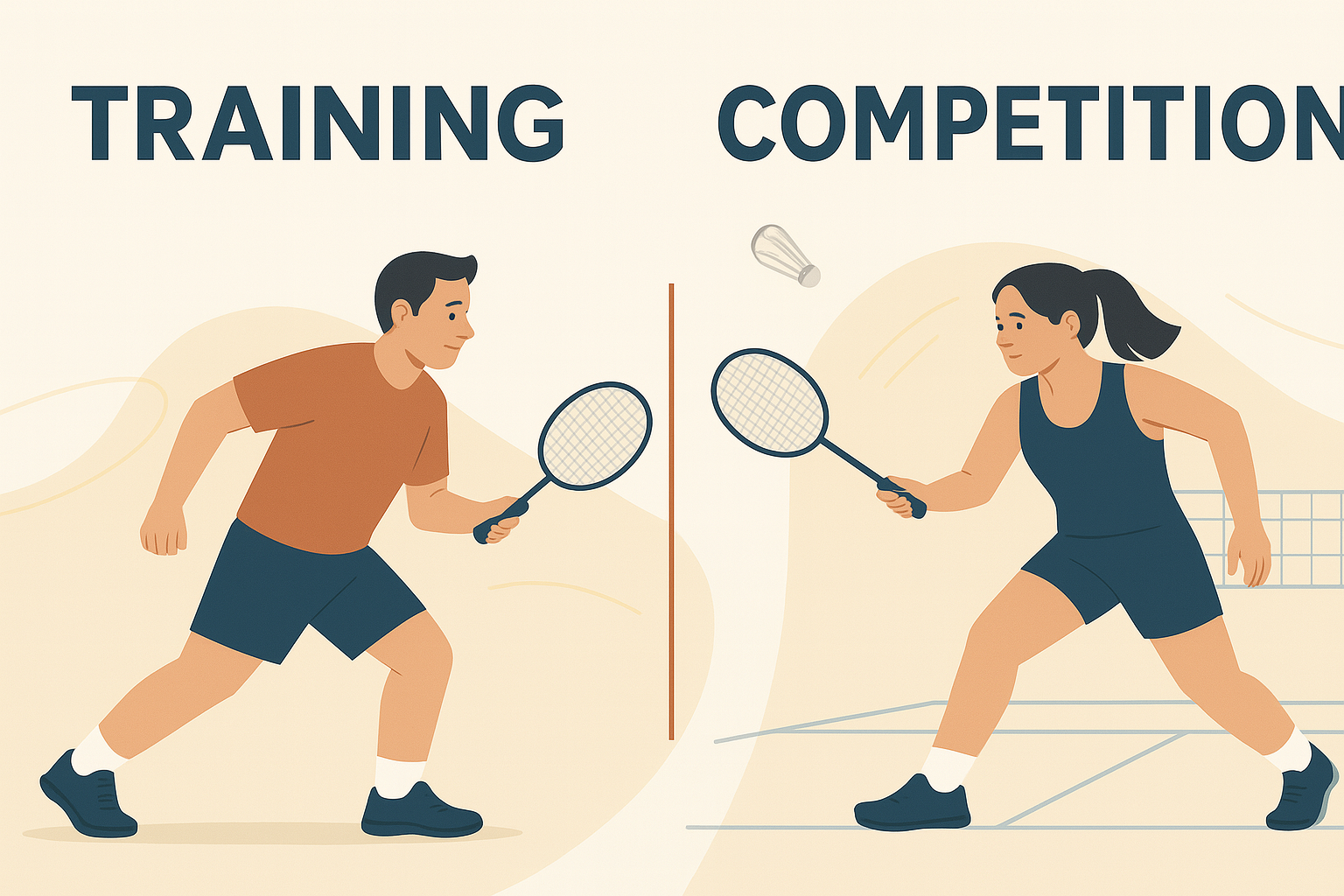
The study by Dacal et al. (2025), published in Applied Sciences, compares the internal and external load responses of multi-feeding drills (MF) and simulated match play (SMP) in elite junior badminton players. These two training formats are widely used in performance development, yet their specific load characteristics remain insufficiently understood. The primary aim of the study was to determine whether MF and SMP elicit different internal and external load profiles. A secondary objective was to evaluate whether sex influences the players’ responses.
Summary of Key Aspects
Study Design and Participants
A crossover repeated-measures design was used, involving 42 elite junior badminton players (24 males, 18 females), aged between 16 and 18 years. All players trained more than five times per week and were classified as Tier 3 (“Highly Trained”) athletes. Each participant performed both MF and SMP sessions, with at least 48 hours of recovery between them. The testing was conducted during the final phase of the competitive season.
Training Formats
Multi-Feeding (MF)
The MF session included six 5-minute blocks, each structured around repeated cycles of 10 seconds of work followed by 7 seconds of passive recovery. Drills were based on full-court tactical patterns (neutral, offensive, and defensive situations), and the shuttle was delivered by either racquet-feeding or hand-feeding. Players rotated across three roles within each block: two active and one feeding. This design allowed high control of intensity and movement variability while simulating realistic gameplay scenarios.
Simulated Match Play (SMP)
SMP followed official BWF singles match regulations, including:
- The 21-point rally scoring system
- 60-second breaks at 11 points
- 2-minute breaks between games
- Court switches between sets
- Tie-breaks to 11 points when necessary
Players were paired by ranking to ensure competitive balance. Matches were conducted under standard indoor conditions and video recorded. No manipulations were applied to influence pacing, rhythm, or duration beyond standard rules.
Measurements
Internal and external load variables collected included:
- Relative Distance (RD, m/min)
- Maximum Acceleration (AccMAX, m/s²)
- Relative Accelerations (AccRel, n/min)
- Maximum Speed (SpeedMAX, km/h)
- Relative Jumps (RJumps, n/min)
- Average Take-off Force (TakeOffAVG)
- Average Landing Force (LandingAVG)
- Average Heart Rate (HRavg, bpm)
- Maximum Heart Rate (HRpeak, bpm)
- Session Rating of Perceived Exertion (sRPE)
Results
Internal Load
Multi-feeding drills (MF) resulted in significantly higher internal load compared to simulated match play (SMP). Players showed elevated average and peak heart rates, as well as higher session RPE values during MF. These differences were consistent across both sexes, and no sex × format interactions were observed in internal responses.
External Load
MF also led to greater external demands. Players covered more distance per minute and performed a higher number of jumps. Explosive movement was more frequent under MF conditions. While male athletes maintained similar top speeds in both formats, female athletes achieved higher maximum speed during SMP. No significant differences were observed for maximal acceleration, take-off force, or landing force.
Conclusions and Practical Application
The results demonstrate that multi-feeding drills produce higher internal and external loads than simulated match play in elite junior badminton players. MF elicited greater cardiovascular responses, higher perceived exertion, longer distances per minute, more explosive actions, and increased jump frequency. These effects were consistent across sexes for internal load measures. However, external outputs such as jump frequency and speed varied between males and females.
The study confirms that MF and SMP represent distinct training formats, each with different load characteristics. Understanding these differences may aid coaches in choosing appropriate training strategies based on specific goals.
Notably, the absence of significant sex × format interactions in internal load indicates that both male and female athletes are similarly challenged physiologically during MF sessions. Nonetheless, coaches should be aware of the lower external mechanical outputs observed in female athletes, such as lower jump frequencies and peak speeds, and adapt workloads accordingly.
Lastly, the study did not assess technical performance or long-term adaptation. Future research should incorporate sport-specific outcome measures and assess how different training formats contribute to chronic improvements in performance and injury risk mitigation.
REFERENCE
Dacal, Francisco & Rodriguez-Fernandez, Alejandro & Herrero-Molleda, Alba & Gil-Calvo, Marina & Baiget, Ernest & Seguí-Urbaneja, Jordi & Fernandez-Fernandez, Jaime. (2025). Training vs. Competition: Load and Intensity Differences Between Multi-Feeding and Simulated Match Play in High-Level Youth Badminton Players. Applied Sciences. 15. 7451. 10.3390/app15137451.